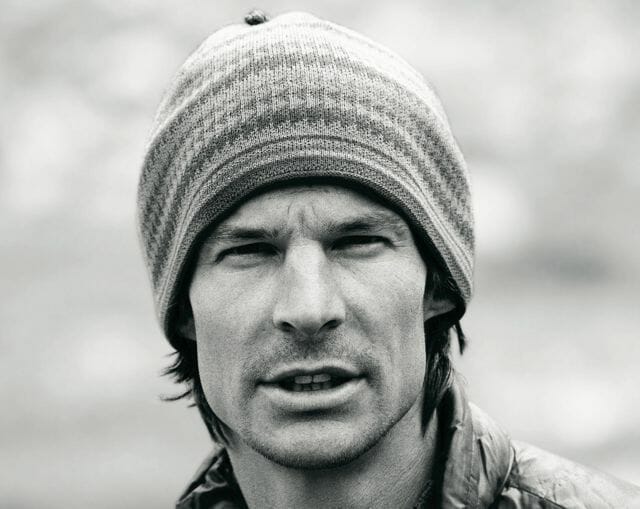
My name is Steve House and I am a climber. I am also a proud husband, a mountain guide, a skier, a cyclist, a traveller, a student, an eagle-scout, and a red-neck by birth. I live in Colorado with my wife Eva, though we typically spend as much time in Europe and Asia as in Colorado. I was born in 1970 in the state of Washington and I have one younger sister, two nephews and a niece. I speak the Slovenian language fluently and am learning German.
I was exposed to climbing by my father who had learned the ropes while in Europe in the 1960’s. As far as anyone remembers I was seven or eight years old when he had me rappel off a small boulder of granite. In high school, I joined an outdoor-club called the Cliffhangers. We did some climbing and backcountry ski trips and many of my buddies got into climbing and several of them were quickly better than me. A group of six of us climbed a lot together, and my friend Todd lead 5.10 (Karate Crack to the Peapod at Smith Rock) two years before I would lead that grade.
After graduation I decided on a year-long exchange program where I was sent (I didn’t have a say in my destination) to Yugoslavia, specifically to Slovenia. It was there that my taste for alpine climbing was whetted. Within two months I was plugged into a local climbing club, and was known to be willing to go climbing anytime, anywhere, with anyone. I climbed 180 days that year. I was also introduced to training for climbing at the club’s weekly training sessions conducted by a professional coach.
Upon returning to the states, I attended Evergreen State College and searched for several years for the kind of climbing community I had in Slovenia. Eventually I found a close approximation to that community in guiding. I started working as a mountain guide as an apprentice at American Alpine Institute at 20 years of age and quickly had a cadre of buddies to climb and road-trip with during the off-seasons. During my tenure at AAI I achieved IFMGA-certification (I was the seventh American to do so) and acquired a lot of great experience guiding in the North Cascades, Sierras, Ecuador, Alaska, and the Alps. In 1995 I graduated Evergreen with a Bachelor of Science degree.
In 1999 I went out on my own as a private mountain guide. I am now partnered with Vince Anderson in Skyward Mountaineering where we focus on low-ratio guiding of advanced ascents. We also offer courses and enjoy taking all levels of climbers into the mountains.
During the 1990’s I focused on climbing in Alaska and Canada largely because those were the two least expensive places for me to climb. After climbing a half-dozen new routes in Alaska, the Slovak Direct route, and the Infinite Spur, I decided that to develop my climbing further, I needed to go to bigger mountains.
In 2002, after five expeditions where I had failed to stand on a single summit, I finally succeeded on a difficult mixed route on a relatively small peak, 6,000-meter Hajji Brakk, which I climbed in a 19 hour solo round trip.
Around that same time I started to be able to make a part of my living through sponsorships and speaking. This was an important coincidence as that allowed me the time and energy to train in an organized manner with a coach. That training gave me the physical and mental endurance to complete my two best ascents to date: K7 and Nanga Parbat.
Though Nanga Parbat is my most famous ascent, the climb that means the most to me personally is the ascent of K7. K7 took a total of seven attempts spread over two expeditions (August ’03 and July ’04). On the first six attempts I failed because I couldn’t find a route which I could quickly and safely solo (first two), because I didn’t get good weather (third, fourth, and sixth), or it simply got dark before I could complete the climb (fifth). On the fifth attempt I failed about 300 feet below the summit. On the sixth attempt I failed about 4,000 feet below the summit. The route involved technical rock climbing at a high standard, vertical ice climbing, and some aid-climbing. K7 is remote and unknown. It had only been climbed once before, taking 19 men 45 days to complete the first ascent. They used a number of (450 reported) bolts and pitons and left all their ropes and camps in place after the ascent.
My chosen style, solo, compelled me to carry a minimum of equipment because I was just one man working alone. After each attempt I removed equipment from my kit that I had found unnecessary. On my successful ascent my backpack weighed seven pounds (3 kg). It was the living example of my own maxim: The simpler you make things, the richer the experience becomes. Of course, I had to sacrifice in terms of suffering and commitment, but I was rewarded in having the richest, most meaningful experience that I have had in climbing.
In 2005, the ascent of Nanga Parbat was made possible for me by three factors: Several years of focused physical training, the collective experience of several Himalayan expeditions, but especially the K7 experience, and finding the right partner in Vince Anderson.
Much has been written and said about the ascent of the central pillar of the Rupal Face of Nanga Parbat and I see no need to write any more about it here. Those who want my version of the story should read my book. Those that want Vince’s version can find it as the lead article in the 2006 American Alpine Journal, available for free online.
After Nanga Parbat I spent a lot of energy and time chasing more big-time success. I continued to climb in the Himalaya at least once a year, but was not successful. Possibly for the complimentary reasons that I increased the difficulty of my objectives and found myself unable to suffer as intensely (or as well?) as I could in 2004 and 2005. In 2010 I had a severe and nearly life-ending climbing accident in the Canadian Rockies. You can read more about the accident here and here.
During my recovery I realized that I had exhausted the potential of focussing 100% of my energy on becoming the best climber I could become. I have found that I could do that, and still more. I am now committed to being a great husband, and hope to become a father. I am developing my powers as a writer, a public speaker, a mentor to younger climbers, and an advocate for our mountain environment. In doing this I will also continue my long-term commitment in supporting a select group of companies whose ideals match mine such as Patagonia and Grivel. I will continue to work as a mountain guide because I find it to be a meaningful and grounding way to share the mountains. I will write more books. And above all, I will climb.